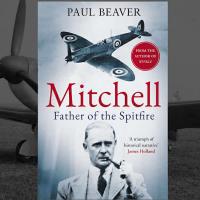
This week saw the eighty-fifth anniversary of the largest, and most decisive, aerial engagement in the Battle of Britain. On 15 September 1940, 31 squadrons of RAF fighters met wave after wave of Luftwaffe planes intent on bombing Britain finally into submission. It didn't work; the Nazis did not achieve the air supremacy necessary to progress with their planned invasion. Instead, 58 German aircraft were downed, and a further 24 were severely damaged. It signalled the effective end of Hitler's attempt to conquer the doggedly determined country across the Channel. It was a great moment in Britain's history, a fight where 'so much' was 'owed by so many to so few'. And at the heart of this momentous battle was an iconic machine: the Spitfire. The release of Paul Beaver's book on Reginald Mitchell, the 'Father of the Spitfire', is therefore perfectly timed.
Mitchell is rightly celebrated for developing the Spitfire. It is, after all, both beautiful and recognizable. Its elliptical wing design stands out; its Merlin or Griffin engine purrs as well as any imaginable big cat. In every way, it was ahead of its time. And it is loved the world over - as well as by the author, who demonstrates with an infectious passion just how remarkable, and important, the Spitfire really is.
But, as Beaver points out, Mitchell's career is far more interesting and varied than 'just' his association with that one magnificent aircraft, and it is high time that a new and thorough biography brings this wider focus to the fore. This is exactly what Beaver does. No longer are the details of Mitchell's early life, his apprenticeship in the railway industry, his involvement in the 'aeronautical World Cup' of its day, and his contribution to another 23 sea- and aeroplane designs are mere footnotes. Instead, Beaver shows just how important each was to the whole, how Mitchell in modern parlance utilized the principles of Kaizen, along with his own experience gained through a lifetime of dedication, to create something close to perfection. The sadness is, when Mitchell died an early death in 1937, he still had so much more to give. The progress of the war - and particularly the war in the air (be it led either by Fighter or Bomber Command) - could potentially have been both shorter and more efficient if only Mitchell had lived a few years longer. But more than this national loss, there is also the awareness of the personal loss for everyone connected with Mitchell - his wife and family, his staff, his friends. The private, as well as the public, sphere is beautifully and sensitively explored.
However, Mitchell was not an island. As Beaver makes clear, and despite what one might hear from certain propaganda films and the people who believe them, more than anything else Mitchell was a 'great conductor', leading a huge team of dedicated men and women through the good times and the bad, the soaring highs and the plummeting lows. In Mitchell, this team is no longer overlooked. While it is impossible to name every contributing person within the narrative, many characters make far more than a cameo appearance. Indeed, the work, skills, and creativity of the Supermarine team members is woven into the overarching narrative in a way that is both respectful and engaging, and gives full credit where it belongs - just as Mitchell would have wanted.
Throughout Mitchell: Father of the Spitfire, Beaver's love of flying - and the machines that enable humans to do so - shines through. His delight in the technicality, his pleasure in describing a particular design feature or flight test, and his sadness when recounting the occasional failure, is palpable. But this is more than just a technical book, or a biography of just one man. The world of the 1920s and 1930s comes alive as much as the machines or the characters do. The winds of political, as well as technological, change are seamlessly laced together and become an integral part of the whole. And just like the Spitfire - and the other aircraft designed by Supermarine - it is lovingly fashioned, displaying skill, elegance, and joy. Mitchell: Father of the Spitfire will, absolutely, become the go-to book for anyone interested in Reginald Mitchell, his outstanding team, and his breathtaking machines.