
What do you do when your army has retreated, your ally has capitulated, and you face invasion? You pray.
That in any case was the experience of the reported 5 million British men and women who, in the aftermath of the Dunkirk evacuation in 1940, took part in ‘The Silent Minute’.
Through this dedicated minute of prayer, it was hoped that the unity of the nation would be welded into a ‘mighty influence by which men and women of goodwill shall help to win the Crusade for a just peace, world-wide brotherhood, and the victory of the Light of God'
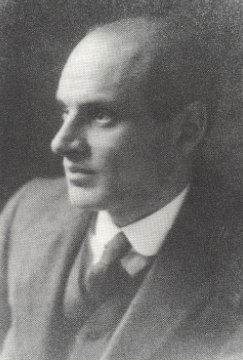
The Minute’s brainchild was one Major Wellesley Tudor Pole OBE, one of the most interesting (perhaps bizarre) men in British history. Psychic, spiritualist and vegetarian (the latter was probably deemed the strangest at the time), Pole rose to public attention in 1904 when his visions led to the discovery of an ancient cup in a Glastonbury stream. For some of Pole’s followers the cup was nothing less than the Holy Grail.
After experimenting with Eastern religion, during the First World War Pole was based in the Middle East where he served in the office of Field Marshall Allenby, leader of the Egyptian Expeditionary Force. According to Pole’s followers it was during Allenby’s campaign to liberate Jerusalem when he learnt of a remarkable conversation between two comrades on the eve of battle. In it one prophesied not only his own death but an even greater conflict to come. As a result, he requested that those who had made the transition to ‘the other side’ be granted an opportunity to participate through the deliberate prayer and silence of the living.
It was out of this moment that the Silent Minute was born. Promoted by Pole during the summer of 1940 when invasion threatened the campaign, it was picked up by devout Christian and Conservative politician, Sir Waldron Smithers MP. Round-faced, bald, friendly (but also reportedly exceedingly dull), the ‘True Blue’ Tory – he was later an arch-critic of the welfare state - was sufficiently connected to bring the Silent Minute campaign to the attention of wartime premier Winston Churchill.
With Churchill, and later the king’s support, the Silent Minute became institutionalized with a minute’s pause being added after the bells of Big Ben were rung at 9pm on Sunday evenings. Later in the war, the campaign was extended to the United States. The two great Anglo-Saxon Christian democracies praying together for peace, freedom, and victory – though due to time-zone differences not at the exact same time.
In fact, the Silent Minute was only one example of a wider program of what historian Philip Williamson has referred to as the British State’s programme of ‘spiritual mobilization’ during the Second World War. This included such events as the National Day of Prayer where tens of thousands of special services were held across the country in fields, offices, military bases, parks and squares as well as churches and halls. The Day of Prayer was considered so important that vital war work paused so that armament workers could take part with services broadcast around the Empire via the BBC. Indeed, the BBC would be one of the key tools used to promote a very British and war-enthused Christianity during the war. Dorothy Sayer’s radio dramatization of the life of Jesus, The Man Born to be King, and C. S. Lewis’s classic talks - later brought together in the hugely influential work of Christian apology Mere Christianity – were first broadcast during the war. Throughout, Christianity, in which denominational differences were carefully smoothed over, was used as a counterpoint to ‘pagan’ Nazism, where the absence of loyalty to anything other than the state was blamed for the violence and cruelty of the war - and indeed for the war itself.
More than just an inoculation against wartime totalitarianism, politicians often saw Britain’s postwar future in religious terms, hence Labour’s pledge to build a ‘New Jerusalem’ from the ashes of bombed out Britain. Nor was this just a left-wing position. As my book Blue Jerusalem: British Conservatism, Winston Churchill and the Second World War attests, Conservatives were equally enamoured with the idea of using what seemed like a wartime religious revival as the basis for their own efforts at rebuilding. Conservative MP and President of the Board of Education, R. A. Butler, for example, dreamt of building a new ‘Christian Civilization’ in Britain and the creation of a new non-party Christian elite to run it.
These ideas are an important reminder that the Britain of the Second World War, for all the continued talk of ‘Blitz Spirit’ and keeping calm and carrying on, is a long long way from our historical present.
However, given the increasing numbers of politicians and thinkers who stress Britain’s historic Christian roots and more and more members of Gen-Z are turning to faith, perhaps the Second World War isn’t so far away after all…
You can purchase Kit Kowol's Blue Jerusalem: British Conservatism, Winston Churchill and the Second World War here.