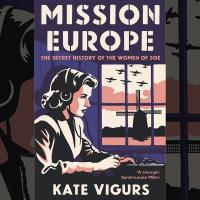
Special Operations Executive was formed in 1940 with one principal task: to ‘set Europe ablaze’. Agents, trained often in Britain but also elsewhere, would go out to the occupied countries of Europe to help win the war against the Nazis from within, to ‘co-ordinate all action by way of subversion and sabotage against the enemy overseas’. They would help native resistance groups, provide training and funding, set up information networks, produce anti-Nazi propaganda, and develop escape lines for prisoners of war and other persons fleeing the Nazi machine, among many other activities. They were an essential part of the war effort.
In the years since many of SOE’s extant files were declassified, people have begun to realise this. Interest has picked up, especially where it relates to F Section – the SOE section that covered occupied France. Indeed, Kate Vigurs’s first book, Mission France, is one of those that has raised awareness beyond the few household names who had gone public last century, rejuvenating the field and drawing the attention of a new generation with spellbinding, detailed, and sometimes harrowing stories of the women involved there.
But F Section was only one small cog in a very big machine. The rest are too unknown, too overlooked, and too misunderstood. Until now.
Vigurs’s new book, Mission Europe, addresses this significant gap with style, sympathy, and skill. This is no mean feat. Researching just one of the female agents who worked for SOE is difficult enough, given the sometimes deliberate, sometimes accidental destruction of official files and the secretive nature of the work. Then extend that to operatives working in six countries, each with vastly differing experiences, and each with their varying collective levels of guilt for collaboration – or pride in resistance. Unsubstantiated rumours and myths that have nevertheless become ‘truths’ built around certain women present another challenge, one that must be approached with tact and consideration. Sorting through the jumble, discovering enough information for a paragraph, let alone a biography, deciphering fact from fiction, and arranging it all into a coherent narrative is more than most authors could manage.
But Vigurs, like the women about whom she writes, has a particular set of skills – and she uses them to the fullest here. The meticulous care taken over the research – much of which was funded through the Special Forces Charity – shows. Commonly held fallacies are flipped, wrongs are righted, and the women emerge from the shadows as fully formed people, with faults and foibles as well as with strength and spirit.
More than this, however, Vigurs is a superb storyteller. She understands that to describe the whole in one go would be too much, too confusing – particularly for those whose knowledge of the Second World War is limited primarily to the experiences of Britain, America, the Holocaust, and perhaps France. So, she doesn’t. Every country has its own, complete account, told chronologically. In the space of one or two chapters apiece, her female agents are brought to life within their own context, surrounded by their particular dangers and opportunities, and supported – or undermined – by those around them. Vigurs’s voice is descriptive, evocative, and clear. But so are those of the women she describes. From a distance of eighty years, much of which clouded by the fog of secrecy and misinformation, this is a sublime achievement. Vigurs’s aim was to address an imbalance, to detail the experiences and missions of the women who worked for SOE across Europe. She has done more than this: she has brought each agent back to life.